
I was talking with a family member a few months back. Now he’s a smart guy, worked hard, followed every workout his phone told him to. But he'd hop programs constantly: three weeks of one plan, then something new because he read that you have to switch things up with your muscles to keep making progress. Six months in, he was tired, sore in new places every week, and was able to see that he’s stronger...nowhere. He asked what my thoughts may be on why nothing was sticking.
Although well intentioned. The problem was him. It was also the plan. Or more accurately, the lack of one.
"Muscle confusion" isn't a term that came out of a physiology lab. Some of you may have remembered those P90X commercials, or even dabbled with those workouts. The term stems from a marketing phrase, popularized by home workout programs in the 2000s to sell the idea that constant variety was the secret to results.
The pitch made sense: keep your muscles guessing, and they'll never adapt, plateau, or get bored. It sounds smart. And was a great way to get people to start moving.
Problem is, it just isn't how the body actually works.
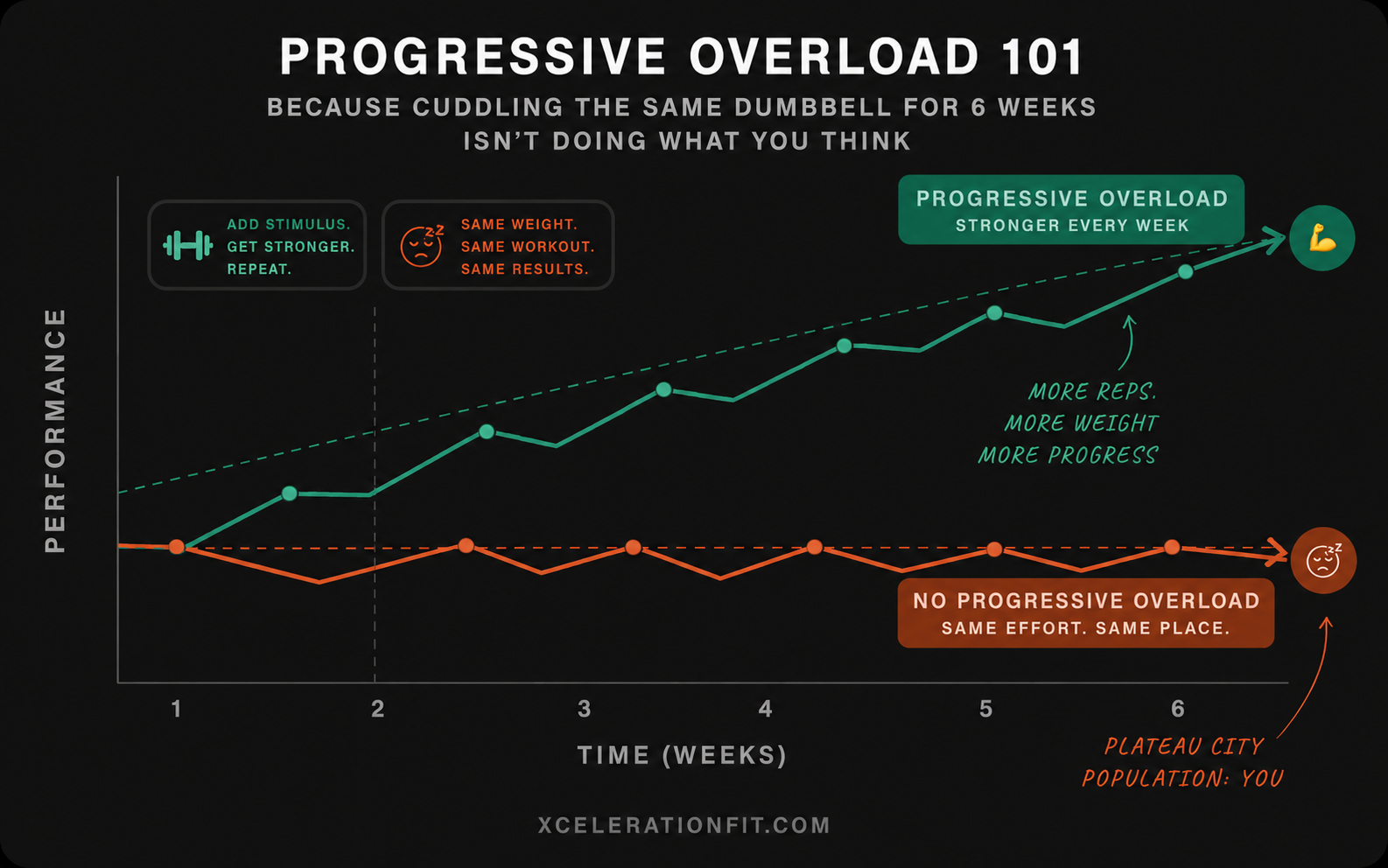
Your muscles don't grow or get stronger simply because they're confused. They adapt because they get challenged consistently, and a little more each time. The technical term, and one you may have heard, is called progressive overload, and it's the single most well-established principle in strength training. It means doing a bit more over time: a little more weight, a rep or two more, better control on the same lift.
The problem with constantly switching things up becomes that you never get the chance to actually get better at anything. Every new program starts you back at square one relearning the movement, figuring out the right weight, and building the coordination before you've had a real shot at pushing it further. You're always practicing. You're rarely progressing.
Some research has looked directly at this. Studies comparing constantly varied training to programs built around progressive overload on a smaller set of core lifts consistently find the latter drives better strength and muscle gains. Novelty doesn't stimulate growth. Demand does.
Let’s not demonize the “muscle confusion” thought process though. There is real legitimacy in workouts and progress stalling out due to boredom, staleness, and lack of variety. If you do the exact same workout, same weights, same everything for a year, you probably will stall out, and you'll likely lose interest in the process too.
But randomness isn’t going to be the fix you think it is, it's structure.
Keeping this in mind is exactly why our programming doesn't chase novelty, but also doesn’t follow along with what I said above.
We don't have you doing the same exact workout week after week, the exercises, rep schemes, and equipment do change. But underneath that variety, we build everything around the same core movement patterns: your squat, your hinge, your push, your pull, your carry. Session to session, week to week, you're continuing to reinforce those same fundamental patterns, just with enough variation to keep things engaging and to train the pattern from different angles.
When I hear people talk about "muscle confusion," that’s the part that I feel gets missed almost entirely. Skill and strength in a movement pattern is what allows you to actually load it safely and progressively over time.
When you keep showing up to squat, even if the specific variation changes from Goblet Squat to Split Squat, your body gets better and better at squatting. That competence is what lets us keep adding weight, reps, or complexity in a way that's safe and effective.
So the variety you feel in our programming isn't random, and it isn't there to "confuse" anything. It's there to build a more well-rounded, durable version of the same movement, while giving you enough variety to not have the workout get mundane. And best of all, the pattern itself stays consistent enough for you to actually get stronger at it.
If you've been the person hopping from program to program with nothing to show for it, that's usually a sign you need a plan built for you, and stop the trial and error. Come in for a trial session and we'll show you what that actually looks like.







%20image.png)