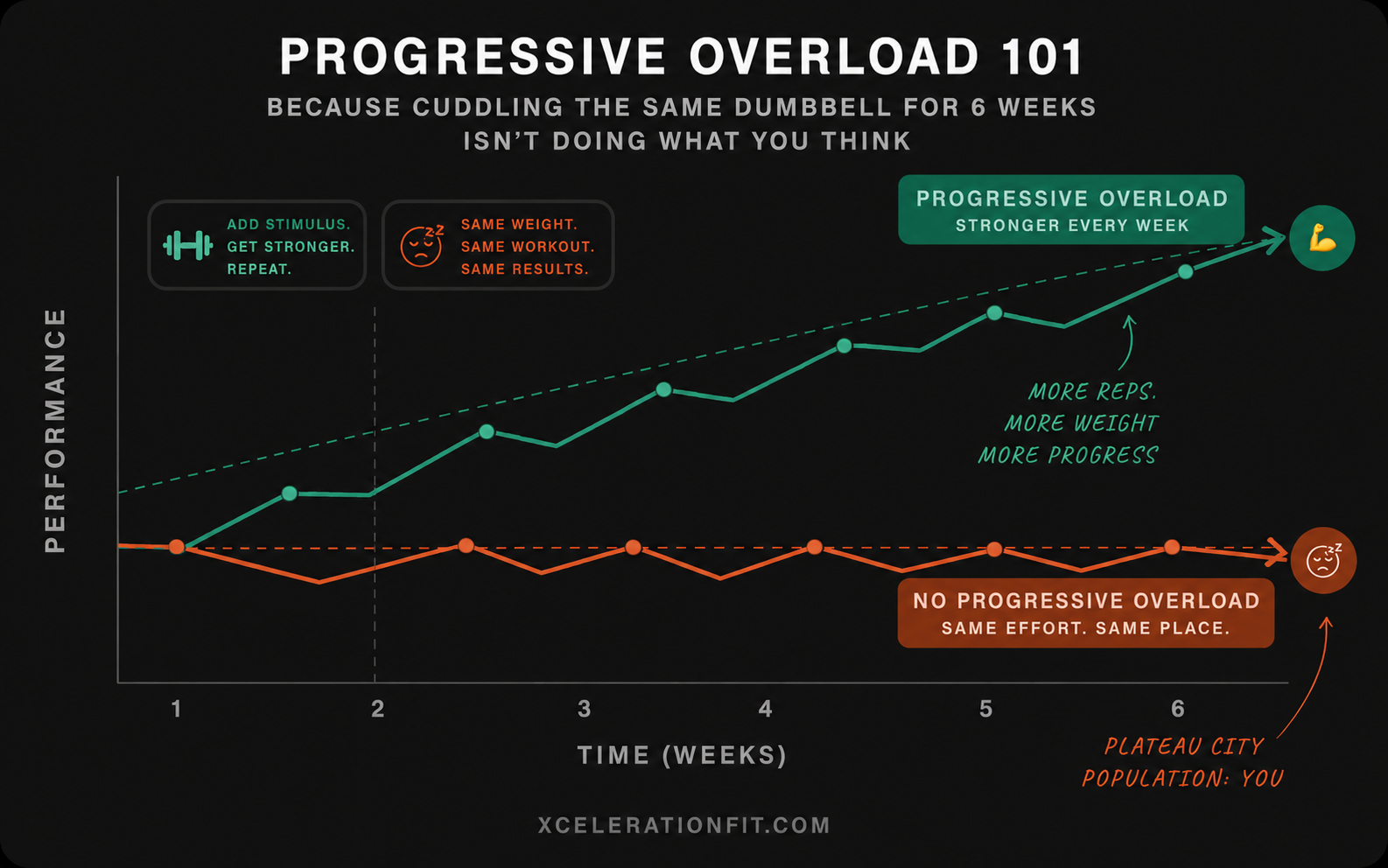

Raise your hand if you've been lifting the same weight for the same number of reps for the last six weeks, or god forbid 6 years (I’m looking at you, and you know who your are) and wondering why your body looks and feels exactly the same as it did a month ago, you're not alone. But you are probably doing something wrong. You're missing the one principle that drives almost all strength and muscle gains, and you’ve probably heard it before: progressive overload.
Progressive overload doesn’t need to be complicated, but like anything, it’s very easy to get to far in the weeds. The good news – our coaches do that part for you, as you’ll see below. But it doesn’t work very well if you don’t do your part and know how to tell if you’re putting in the right effort, because the weight of dumb bell only needs to tell half the story.
Progressive overload means gradually increasing the demand you place on your muscles over time. And I say it all the time, our bodies are incredibly good at keeping us alive and adapting. The first time you do 10 push-ups, it may suck and be quite a challenge. By the 50th time, it's a warm-up. If not, you might not be giving yourself a chance to adapt.
Once your body adapts, it stops changing unless you give it a reason to. This is also why progressive overload matters more than most of the things people obsess over in the gym. More important than "muscle confusion" (switching exercises constantly). More important than a specific rep scheme. More important than the supplement aisle. If you're not doing your part (effort) in progressively overloading, none of that other stuff will move the needle much.
Adding and increasing weight lifted is the most obvious way to overload a muscle, but it's far from the only one. Here are five ways to do it:
That last one trips a lot of people up. If your squat depth has improved, or you're finally hitting full depth on your push-up, your muscles are doing more work even though the weight is identical. Don't poo-poo that as "no progress."
Here's the part that separates people who progress steadily from people who feel stuck: knowing how hard you're actually working.
If you’ve spent any time at Xceleration, you’ve no doubt heard a coach ask you after your last set, "Could you have done one more rep? Three more? None at all?" This is sometimes called RPE (Rate of Perceived Exertion) or "reps in reserve," and is the simplest way to know if you’re actually going to get stronger, or improve on an exercise. It’s a personal gut check.
I want to be clear, I don’t believe the mistake here to be laziness. I think we often confuse hard with maxed out. A set can feel genuinely difficult and still leave two or three reps in the tank. If you're stopping a set because it "feels hard" rather than because you physically couldn't do another clean rep, this may be why you’re not making the improvements you feel you should.
Learning to read this signal accurately takes practice, but it's the single best tool you have for knowing when — and how much — to push.
So how do you actually know it's time to bump the weight up? Here’s typically what a coach is going to be looking for:
Now apply that same lens on your own. Here’s how you can gauge yourself:
The more honest you are with yourself, the more accurate your self-assessment becomes. Most people who stall out aren't doing so because they lack the strength — they're either adding weight before they've truly earned it, or they're staying put long after their body was ready to move on.
When you do add weight, smaller jumps are almost always the smarter move. For upper body lifts, think 2.5–5 lbs. For lower body lifts, 5–10 lbs is usually reasonable. It's tempting to jump bigger once you're feeling confident, but adding too much too fast is one of the fastest ways to get the stink eye from a coach, but more importantly form breakdown is how plateaus and injuries both start.
Here's where self-gauging your effort helps. After you add weight, look at your effort on that "should be hard" set (usually the last 2 sets):
We want to use effort as a tool for deciding when to add weight, but it's also your feedback loop for whether you added the right amount.
If you want to see progressive overload in action without having to design it yourself, be on the lookout for our Fitness Ladder Challenge next week! The weight tiers are built around exactly this principle — but if you’re looking to improve something, you have to get a baseline somewhere.
And if you're ever unsure whether it's time to add weight, or whether you're reading your own effort accurately, ask a coach. That’s what we’re here for. Getting a sense of what you’re capable of and your sense of effort is a skill. It's also one we can help you build faster than trial and error alone.
Keep progressive overload simple: give your muscles a reason to adapt. But it only works if you're tracking the right signals. Weight of the dumb bell and bar matters, but so does honestly reading how hard you're actually working. Get both of those right, and the fun begins!








%20image.png)