
In case you may not have noticed, most fitness advice you come across on social media is either from some 25-year-old that’s still ripe in life experience. Or it’s layered in “scientific data” that gets taken out of context for the sake of sounding smart and credible.
All of this can be overwhelming and make you feel as though you’re missing something. But when you start to hit those middle ages, and you’re putting in consistent, real effort, it can be frustrating if you’re not getting the results.
We’re always going to be our harshest critics, so the reality is you’re probably not doing anything inherently wrong — you might just be using the wrong playbook for what you’re after.
Here at Xceleration, all our new members all start out with an onboard evaluation, which includes a DEXA body composition scan, to help decide what lever we need to pull to solve the problem you’re struggling with.
Again, a lot of times it’s simple tweaks or common mistakes that may be impeding your ability to start seeing results early on. So here are the five mistakes we see most often.
Cardio is the default for most adults as it generally has a lower barrier of entry. Plus, cardio feels safer to most people — it’s familiar, and your feeling of doing something hard is immediate (you sweat, your heart rate goes up, you feel accomplished). An 18-month study in the journal Obesity found that resistance training preserved twice as much muscle during weight loss compared to cardiomeaning what muscle you already have isn’t going away. Cardio burns calories, but doesn’t send your body the signal it needs to hold onto that muscle you’ve worked so tirelessly to build.
Unlike just throwing on running shoes, strength training absolutely can feel intimidating, especially in a gym environment where you’re not sure what you’re doing or whether you’re doing it right. But find the right fit for you, and a coached group training generally solves this kind of problem. An 18-month study in the journal Obesity found that resistance training preserved twice as much muscle during weight loss compared to cardio — with similar fat loss between groups. Cardio burns calories but doesn’t send your body the signal it needs to hold onto lean tissue. That’s where hitting 2-3 days of strength training can really move the needle. It should be the foundation of your program, not an afterthought.
Decades of diet culture have trained a lot of people — especially women — to associate eating less with doing better. Eating a bigger portion of anything, even protein, can feel counterintuitive when the message has been “less is more.”
A simple correction I’d recommend would be to build every meal around protein first, then fill in around it. Eggs at breakfast, Greek yogurt as a snack, chicken or fish at lunch and dinner. Aim for a palm-sized serving of protein at every meal, which gives you roughly 20–30 grams. If you’re frequently eating meals where protein is the side character (a salad with a few chickpeas, a bowl of pasta with a little meat sauce), it’s going to help lead everything to fall into place.
Sleep deprivation has become quite the norm nowadays, and with more things competing for your time and attention, it’s only getting worse. Busy people seem to just accept that they aren’t going to be able to get the recommended amount and not think it could be the cause of some of their problems they are looking to solve.
Sleep is one area where it’s hard to deny the facts, as the science is completely unambiguous and straight-forward. You need sleep. You just absolutely cannot out-train bad sleep. No workout, no supplement, no nutritional strategy compensates for chronically disrupted recovery. According to research published in Physiological Reports One night of total sleep deprivation reduces muscle protein synthesis by 18%, raises cortisol by 21%, and drops testosterone by 24%, according to research published in Physiological Reports. Poor sleep nights stacked on top of each other can quickly be the biggest thing impeding your progress and undo a meaningful portion of what your hard work in the gym, and in the kitchen, is trying to accomplish.
Start easy. Set a hard stop, non-negotiable cutoff for screens, work, or workouts at night. Even shifting sleep 30 minutes earlier consistently makes a measurable difference. Another thing to keep in mind is the effects of alcohol, which fragments sleep quality significantly because of all the other areas that it can impact; addressing either one (late bed-times or alcohol consumption) often improves sleep without adding any hours.
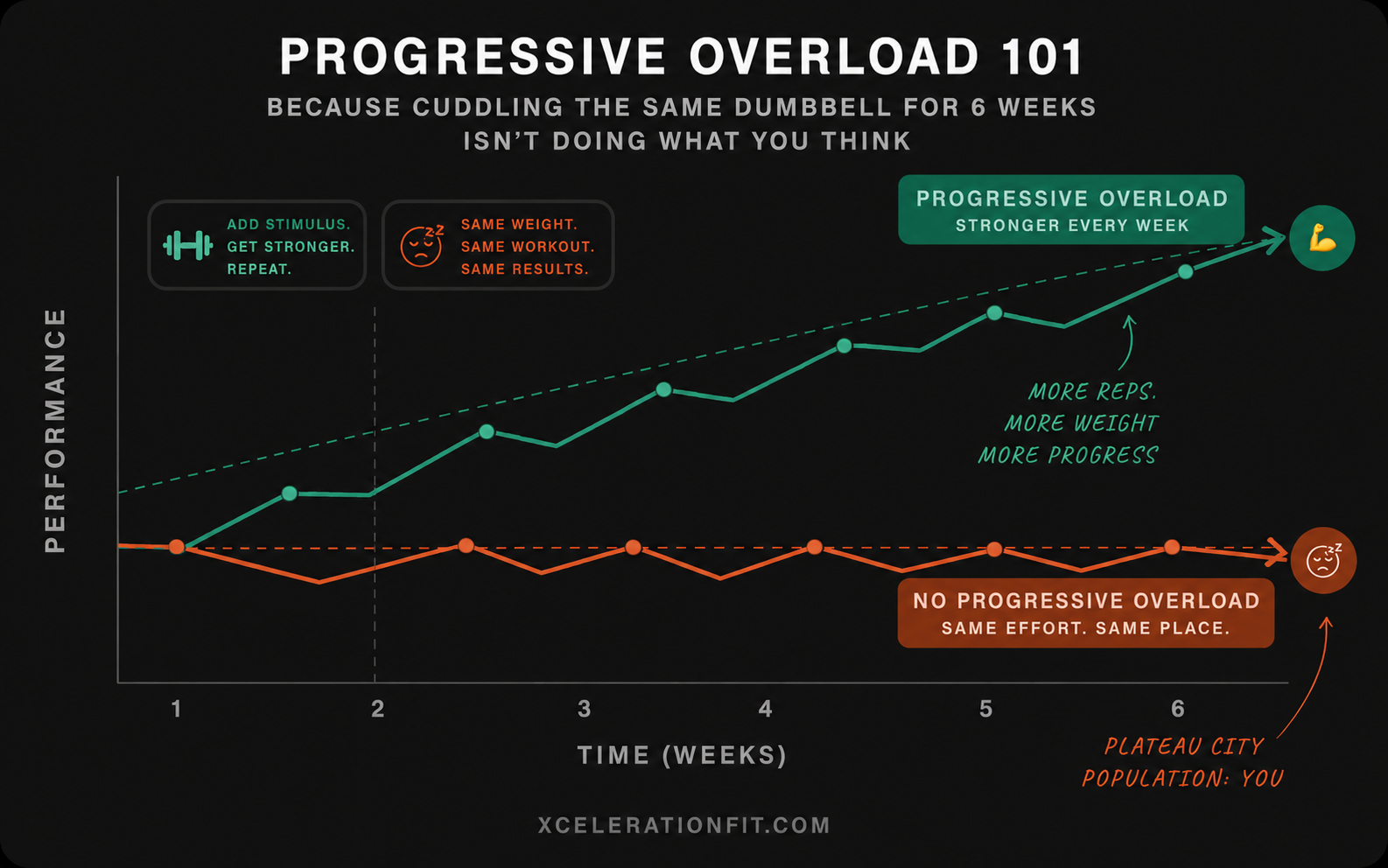
This mistake comes in two forms: doing the same workout for years with no change, or going all-out every session until you burn out. Both miss the same thing — progressive overload, the gradual increase in training demand that drives adaptation over time.
Two very different psychological patterns drive these two versions of the mistake. The stagnation version is often rooted in wanting to feel comfortable. You want the workout to feel manageable and familiar. Challenging it introduces the possibility of failure or struggle, which no-one likes to feel. On the flip side, overtraining is often rooted in the belief that more always means better, or that rest means progress stops. Neither is true.
If you’ve been doing the same workout, or weights on your core lifts, for more than 6 weeks without increasing load, reps, or difficulty in any way, you need to add something. Even one more rep per set, or five more pounds on one movement, will signal to your body that it needs to adapt.
If you’re on the other end and training at maximum intensity every session or feeling consistently run down, I'd look into one deliberate recovery day between hard sessions and monitor how your workout a couple days later feels.
Ahhh the age old conundrum, and discussion amongst fitness coaches. For many people, the number on the scale carries enormous emotional weight, sometimes letting it determine how they feel about themselves that morning, what they eat that day, or whether they feel like their efforts are “working.”
That’s a totally understandable feeling, but can be depressing if you keep putting a lot of stock in it. Weight fluctuates by two to four pounds day to day based on many daily factors like water, food volume, sodium, and hormonal shifts that you may or may not have control over.
Add one or two non-scale metrics to how you measure progress. How your clothes fit. How much weight you’re lifting compared to six weeks ago. Your energy levels throughout the day. Your recovery between sessions. Don’t just pick feel-good things, choose legitimate indicators of body composition change like these that the scale simply cannot show you. And if you want objective data, a DEXA scan is going to be better because it gives you actual numbers as well as a conversation starter for where to put your energy for the biggest result payoff.
None of these mistakes make you someone who isn’t trying hard enough. If anything, the people we see making them most often are the ones putting in the most effort, just need to help figuring out what lever to pull.
The encouraging part is that small adjustments to the right things add up quickly. Protect your sleep, anchor your meals around protein, get some intention behind how you’re training, and stop letting the scale be the only thing that tells you whether it’s working. Most of the time, even though it seems so simple, it’s enough to start seeing progress that makes you want to keep up on the reinforcing the new changes you’re trying to implement.
If you’re not sure where to start, or you just want someone to look at what you’re actually working with — that’s exactly what our intro session and DEXA scan are for. Come in, get the data, and let’s figure out together which lever is going to make the biggest difference for you.








%20image.png)