How many of these can you relate to:
You haven't changed much.
Same eating habits you've had for years. Same general activity level. Maybe a little less intense than your 30s, but nothing dramatic. Your weight is within a few pounds of where it's always been.
And yet, you feel a bit off. The way your clothes fit. The softness around your midsection that wasn't there before. The feeling that your body looks less toned, less athletic, somehow less you, even though the number on the scale hasn't moved much.
You're not imagining it. And you're not necessarily doing anything wrong.
What you're experiencing has a semi-polarizing name — skinny fat — and it's one of the most common, most misunderstood, and most frustrating body composition shifts that happens to men AND women after 40. The tricky part is that it can happen without any meaningful change in your diet or your weight. Which is exactly why it catches so many people off guard.
So what's actually going on?
Starting in your mid-to-late 30s, and accelerating through your 40s and 50s, your body begins losing muscle mass at a measurable rate.
The clinical term is sarcopenia, age-related muscle loss.
It's a normal, well-documented biological process that affects virtually everyone who isn't actively working against it.
Research recently published confirms that muscle mass decreases approximately 3–8% per decade after the age of 30, with the rate of decline accelerating further after 60. [1] But here's what makes this particularly sneaky: the scale often doesn't show it.
That's because as muscle is lost, it tends to be replaced very gradually, and invisibly by fat tissue. Your total body weight stays relatively stable. But the composition of that weight shifts. You now have less muscle and more fat mass, but be seeing the same number on the scale.
And this is essentially what the heart of the skinny fat problem is.
It's not always about eating more or moving less.
It's a slow, quiet internal reorganization that most people don't even know is happening until they don't like what they see in the mirror — or until a DEXA scan reveals a some numbers that surprises them.
So what are some of the not so obvious factors that can influence this?
Anabolic hormones decline. Testosterone, estrogen, growth hormone, and IGF-1 (Insulin Growth Factor) are the main hormones in your body that support muscle building and maintenance. Sadly, these all begin declining in your 40s. Now I want to be clear on this next part, it DOES NOT mean your body CAN'T build or maintain muscle. It means it becomes less efficient at it. Making it imperative for you to understand that you'll need to do more of the right things just to hold your ground.
Protein synthesis slows down. Even if you're getting enough protein (~100g minimum for women, ~120g minimum for men) your body's ability to convert that protein into muscle tissue becomes less efficient with age. Older muscle is simply harder to maintain and rebuild than younger muscle. So your body needs a trigger to let it knows how to respond. Best trigger is this case comes in the form of resistance training. Making it even MORE important for general health and weight loss, not less.
Recovery takes longer. The window between stimulus and adaptation widens with age. Your muscles need more time to repair and rebuild after stress. If you're not training consistently enough or at all, your body doesn't have a reason to hold onto the muscle it has, so it starts losing it.
Life gets in the way. In your 40s, you're often managing job life, kids, aging parents, stress, and less sleep than you'd like. All of these factors, particularly elevated cortisol from chronic stress and poor sleep, signal your body to break down muscle tissue, instead of preserve it.
None of this is inevitable, but you have to understand what's driving it before you can push back effectively.
This isn't just about how your jeans fit, although that's a completely legitimate thing to care about.
Muscle is metabolically active tissue. Meaning your body burns calories at rest. It also means that when we have more of it, we get improved insulin sensitivity. Higher bone density, protectecting your joints.
It's the single most important thing we can control when it comes to our long-term health.
Above all, it determines how well you move, how independently you age, and how quickly you recover from illness or injury.
When muscle is replaced by fat, particularly visceral fat, the fat that's around your organs, your metabolic rate slows, your risk for type 2 diabetes increases, your cardiovascular risk profile changes, and your functional capacity quietly declines.
I totally understand that optics and sensitivity around the label "skinny fat." But the skinny fat problem isn't cosmetic. It's a body composition issue with real downstream health consequences. And it's almost entirely invisible on a standard scale.
This is part of why we talk about DEXA scans so often. A scale tells you how much you weigh. A DEXA scan tells you what you're made of — your actual muscle mass, your actual fat mass, and where that fat is distributed.
For a lot of people, those results are the first time they've ever seen what's really going on inside their body. And it changes how they think about their health.
A lot of times that scan is the real kick in the pants that they've been missing.
So once that realization hits home that some changes need to start being made. It's also where a lot of well-intentioned people accidentally make things worse.
When people start noticing the skinny fat shift, the instinct is often to do more cardio. Walk more. Run more. Hit up the nearest Orange Theory. Burn more calories.
And it makes incredibly perfect sense on the surface. But for this specific problem, chronic cardio without resistance training is not the answer, and in some cases, it actively worsens body composition.
Here's why: cardio burns calories, but it doesn't provide a strong enough stimulus to preserve or build muscle tissue.
When you're in a calorie deficit and doing primarily cardio, your body will draw from both fat and muscle for energy. You may lose weight, but you'll likely lose muscle along with it. This is the rub were trying to avoid because doing so pushes your body composition further in the wrong direction, even as the scale goes down.
This is how people end up smaller but still soft. Lighter, but still not feeling strong. The skinny fat problem gets worse even as the number on the scale improves.
The fix isn't to stop moving. It's to shift the emphasis and fully buy in.
Resistance training.
Full stop.
Specifically, progressive resistance training, like we do here at Xceleration. Lifting weights in a way that challenges your muscles and gives your body a reason to build and maintain lean tissue.
This is the only training stimulus that directly addresses the root cause of the skinny fat problem.
Think of it as you telling your body: hold onto this muscle, we need it. I want to be stronger. I want to get rid of these hormonal frustrations. I want to burn more calories at rest. And done consistently over time, it changes your body composition in a way that cardio alone simply cannot.
"Consistently" is the key word.
This is not a six-week program. It's not a boot camp you do until the wedding. It needs to be a permanent change in how you approach your health because the forces working against your muscle mass aren't going anywhere. As long as you're aging, sarcopenia is happening.
The only effective countermeasure is ongoing, coached resistance training.
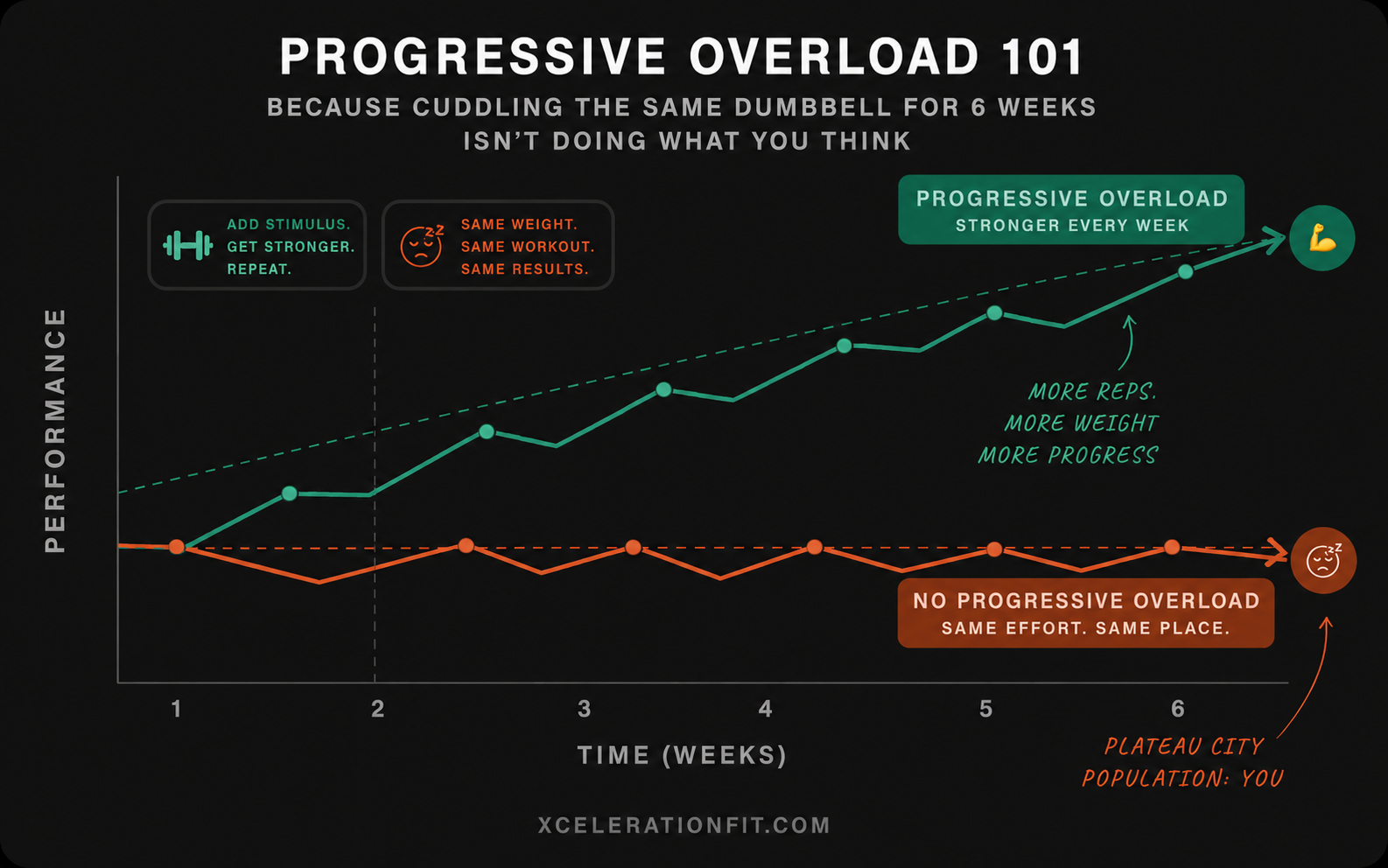
The dose matters too. Research generally supports two to four sessions per week of resistance training to meaningfully preserve and build muscle in adults over 40. Volume, load, and progressive overload all factor in.
This is precisely why having a coach, rather than wandering through a gym on your own, makes such a measurable difference in actual outcomes.
If your body has changed in ways you didn't expect, despite no major shifts in your diet or your weight. You're not failing.
You may be experiencing a predictable, well-documented and incredibly frustrating biological process that most people are never told about until they're fed up, confused, and ready to throw in the towel.
The good news is that this is one of the most reversible problems in fitness. Muscle responds to training at any age. Body composition can change at any age. The skinny fat shift does not have to be permanent.
But it does require the right approach.
Not more cardio.
Not a stricter diet.
Not a cleanse or a program that promises fast results.
The right tool is finding a consistent, enjoyable, and progressive weight training routine.
That's exactly what we do here. If you've been nodding your head through this entire post and thinking this is me — let's talk. A DEXA scan and a coaching conversation might be the most useful hour you spend this year.
Xceleration Fitness has been helping adults over 40 build real strength and improve body composition for 12 years. Our coached group training model, DEXA scan assessments, and personalized programming exist for exactly this reason. [Schedule your intro session here.]







%20image.png)